
Your contact center runs on Genesys Cloud. Or Five9. Or Talkdesk. Whichever platform you chose, it came with bundled voice connectivity. You pay per seat, per minute, and per feature. The calls work fine. But every quarter, your finance team flags the same line item: voice costs are climbing faster than call volume, and nobody can explain why.
Here is why. When your CCaaS provider bundles PSTN connectivity into your subscription, you are paying their markup on carrier services. They buy wholesale minutes from a SIP trunking provider, add a margin, and pass the cost to you inside a single invoice. It is convenient, but it is rarely the cheapest option. And you have zero visibility into the underlying carrier costs.
Bring Your Own Carrier, or BYOC, is the alternative. Instead of using your CCaaS vendor's bundled voice, you connect your own SIP trunking provider directly to your contact center platform. You buy carrier minutes at wholesale rates, keep control of your phone numbers, and separate your voice costs from your application costs.
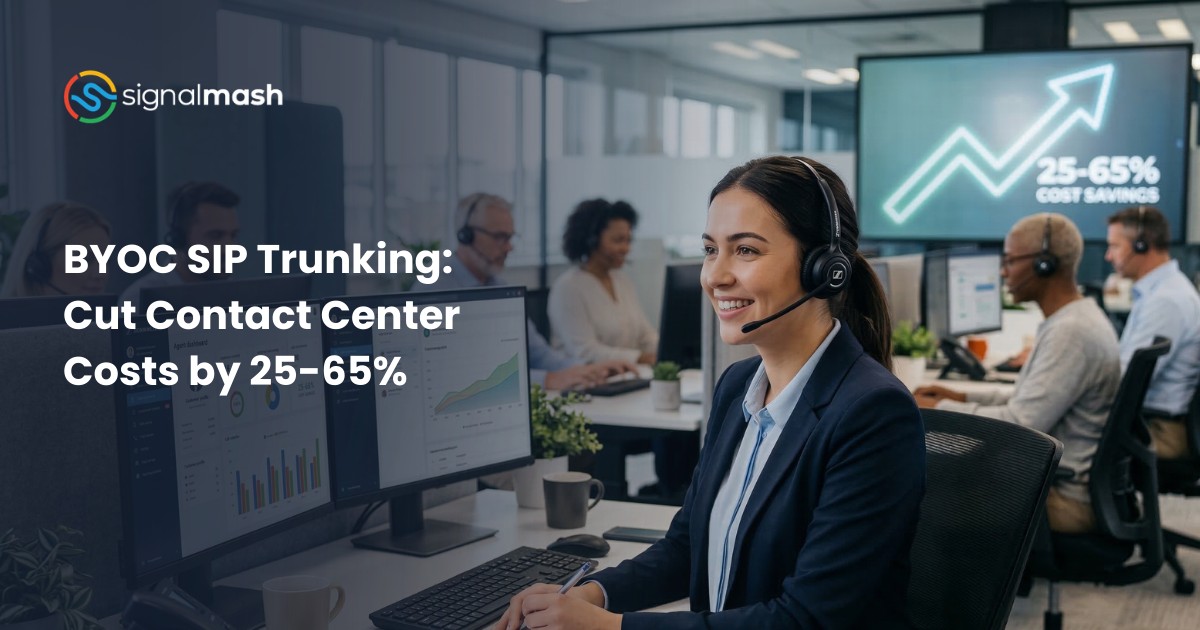
The savings are real. Businesses that switch from bundled voice to BYOC SIP trunking typically reduce their PSTN costs by 25 to 65 percent, depending on their call volume and existing contract terms.
What Is BYOC and How Does It Work?
BYOC is an open telephony interface provided by UCaaS and CCaaS platforms that lets you connect a third-party SIP trunking provider for your PSTN (public switched telephone network) connectivity. Instead of your contact center platform handling both the application layer and the voice connectivity, those two functions are decoupled.
Your CCaaS platform handles call routing, IVR menus, agent distribution, reporting, and all the application-level features you chose it for. Your SIP trunking provider handles the actual phone calls, delivering and receiving PSTN calls through direct carrier connections.
The connection between the two happens over SIP, the Session Initiation Protocol. Your SIP trunking provider sends and receives calls through your CCaaS platform's BYOC interface, and the experience for your agents and customers is identical to using bundled connectivity.
Today, 8 out of 10 leading UCaaS and contact center platforms offer a BYOC option. Genesys Cloud, Five9, Talkdesk, Zoom Phone, Microsoft Teams, and several others all support BYOC connections.
Why BYOC Saves 25-65% on Voice Costs
The cost difference comes from three places.
Wholesale versus retail pricing
Your CCaaS provider buys carrier minutes at wholesale rates and resells them to you at retail. When you buy directly from a SIP trunking provider like Signalmash, you access wholesale rates without the middleman markup. For high-volume contact centers handling thousands of minutes per day, this difference adds up quickly.
Consolidated buying power
When your PSTN connectivity is bundled with your CCaaS platform, that voice spend is fragmented. With BYOC, you can consolidate all your voice traffic, including contact center, office phone system, and other voice applications, under a single SIP trunking provider. Higher total volume means better rates.
Competitive pressure
When your voice connectivity is locked into your CCaaS subscription, you have no leverage to negotiate rates. BYOC lets you evaluate SIP trunking providers independently and switch if you find a better deal, without changing your contact center platform.
BYOC Benefits Beyond Cost Savings
Number portability and control
With BYOC, your phone numbers belong to your SIP trunking provider, not your CCaaS vendor. If you switch contact center platforms, your numbers come with you. No porting delays, no renegotiation, no risk of losing numbers your customers already know.
Geographic flexibility
Depending on your SIP trunking provider, you may have access to local numbers and DID coverage in more regions than your CCaaS platform's bundled offering supports. Signalmash provides local origination and termination across the US and Canada with direct Tier-1 carrier connections.
Carrier redundancy
If your CCaaS platform's bundled carrier has an outage, your calls go down. With BYOC, you can configure failover routing through your SIP trunking provider, or even use multiple SIP providers for redundancy. Your voice connectivity becomes independent of your CCaaS platform's carrier relationships.
Elastic scaling
During peak call volumes, seasonal surges, or unexpected spikes, elastic SIP trunking scales your capacity automatically. You do not need to pre-provision channels or negotiate capacity increases with your CCaaS provider. Signalmash's elastic SIP trunking scales with your call volume without requiring upfront capacity commitments.
How BYOC Works with Major CCaaS Platforms
Genesys Cloud
Genesys Cloud supports BYOC through its BYOC Cloud option, which allows you to connect an external SIP trunking provider directly to your Genesys instance. Configuration involves setting up a SIP trunk connection in the Genesys admin console, pointing it to your SIP provider's signaling IP addresses, and mapping your phone numbers to queues and routing flows.
The setup is straightforward for teams familiar with Genesys administration. For those who are not, Signalmash provides integration guides and hands-on support to get the connection running without trial and error.
Five9
Five9 offers BYOC as part of their platform, allowing external carrier connections alongside or in place of their bundled voice. The integration uses standard SIP connectivity, and Five9's administration tools let you manage inbound and outbound call routing through your BYOC connection.
Five9 BYOC is particularly popular for contact centers that need to maintain existing carrier relationships or that require specific number coverage that Five9's bundled offering does not include.
Talkdesk
Talkdesk supports BYOC through their Connections feature, which provides a SIP-based interface for external carrier integration. The setup involves configuring SIP endpoints, defining call routing rules, and testing connectivity before going live.
Talkdesk's BYOC implementation is well-documented, and the platform handles the application-level call management while your SIP trunking provider handles the PSTN connectivity.
Is BYOC Right for Your Contact Center?
BYOC is not the best choice for every contact center. Consider these factors before making the switch.
BYOC makes strong sense when:
Your monthly PSTN costs exceed $2,000 to $3,000 and you have enough volume for wholesale rates to matter. You want to keep your phone numbers independent of your CCaaS platform. You need carrier redundancy or geographic coverage your CCaaS vendor does not provide. You have IT staff who can manage a SIP trunking connection, or you work with a provider that handles it for you.
Bundled may be simpler when:
Your contact center is small, fewer than 20 agents, and your voice costs are a minor line item. You do not have technical staff to manage a separate carrier relationship. You are happy with your current carrier's coverage and pricing. Simplicity of a single invoice and single vendor relationship outweighs cost savings.
How to Evaluate a BYOC SIP Trunking Provider

Not all SIP trunking providers are equal, and the wrong choice can negate the benefits of BYOC. Here is what to evaluate.
Direct carrier connections
Ask whether the provider has direct connections to Tier-1 carriers like AT&T, Verizon, T-Mobile, and Bandwidth. Direct connections deliver better call quality and reliability than routes that pass through multiple intermediaries.
Support responsiveness
SIP trunking issues affect live customer calls. When your trunk goes down at 10 AM on a Monday, you need a response in minutes, not hours. Ask about support SLAs and whether you get a dedicated contact or a ticket queue.
Pricing transparency
Can you clearly calculate your monthly cost before committing? Some providers have complex rate structures with different per-minute prices for local, long distance, toll-free, and international calls, plus surcharges and fees that only appear on the invoice.
Number management
Your SIP trunking provider manages your phone numbers. Make sure they support number porting, offer local and toll-free numbers in the regions you need, and provide an easy way to add or remove numbers as your contact center scales.
Getting Started with BYOC on Signalmash
Signalmash provides elastic SIP trunking with direct Tier-1 carrier connections, built for contact centers that want to separate their voice costs from their CCaaS subscription. Their wholesale voice infrastructure has been running for over a decade, and their support model means you work with real engineers in a dedicated Slack channel rather than waiting in a ticket queue.
The migration from bundled voice to BYOC typically takes 2 to 4 weeks, including SIP trunk configuration, number porting, and testing. Signalmash handles the technical setup and coordinates with your CCaaS platform to ensure a smooth transition with no disruption to live calls.
If your contact center's voice costs are climbing and you want to see what BYOC savings look like with your specific call volume, start with a 15-minute rate comparison. Bring your current per-minute rates and monthly call volume, and Signalmash can show you exactly what the cost difference looks like.