Date:
April 20, 2026
Category:
RCS for Hospitality: Reduce No-Shows and Delight Guests
Your restaurant seats 120 covers on a Friday night. You took 95 reservations. By 8:30 PM, 14 tables have not shown up. That is 28 empty seats during your highest-revenue service, roughly $2,800 in lost revenue accounting for average check size and drink orders. Meanwhile, you turned away 20 walk-in parties because the reservation book said you were full.
Hotels face the same problem at a larger scale. A 200-room property with a 5 percent no-show rate loses 10 room-nights per night. At $200 average daily rate, that is $2,000 in daily lost revenue, or $60,000 per month.
The hospitality industry loses billions annually to no-shows. The standard approach of phone call confirmations and email reminders is not working. Phone calls go unanswered. Emails get lost. The guest forgets, the table sits empty, and the revenue disappears.
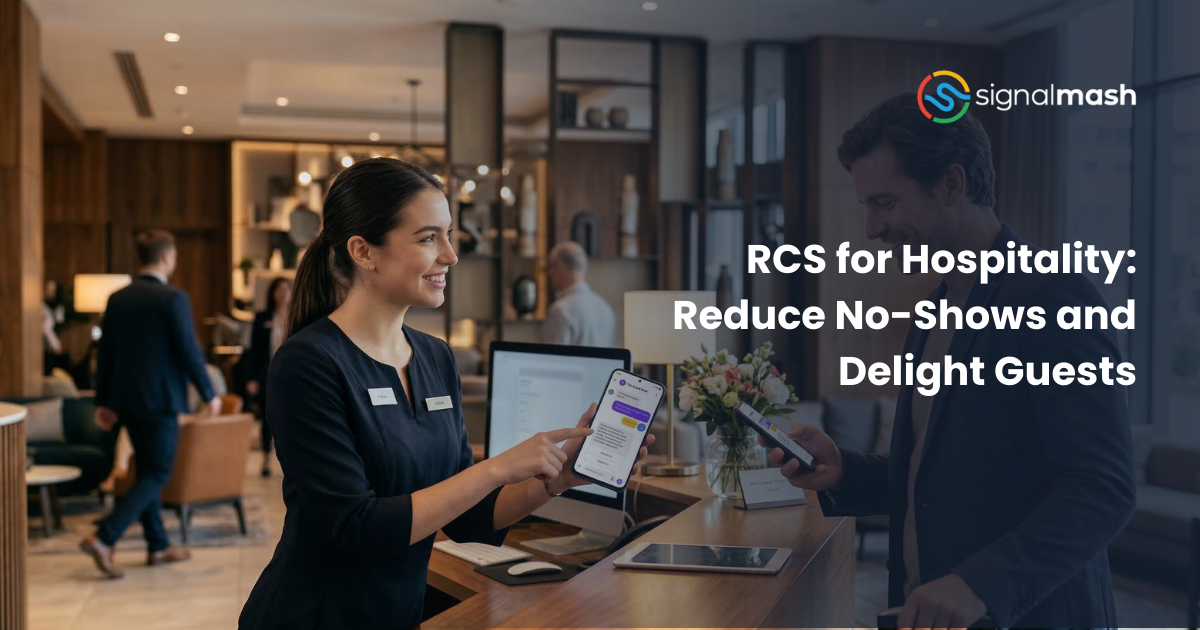
RCS business messaging offers a different approach. A branded message arrives in the guest's native texting app showing your venue's name, logo, and verification badge. Below that, a rich card displays their reservation details: date, time, party size, and any special notes. Two buttons: "Confirm" and "Modify Reservation." One tap and you know whether that table will be filled.
Why Traditional Reservation Reminders Fail
Phone calls are ignored
Staff calling to confirm reservations reaches voicemail 60 to 70 percent of the time. The labor cost of a host or admin spending 45 minutes per shift making confirmation calls is real, and the return rate on voicemails is low.
Email gets buried
Reservation confirmation emails have open rates between 30 and 50 percent depending on the sender. Even when opened, the email often arrives alongside dozens of other messages and gets forgotten by the time the reservation date arrives.
SMS is better, but limited
SMS reminders perform well, with read rates above 90 percent. But a plain text message that says "Your reservation at Bistro 45 is tomorrow at 7 PM. Reply C to confirm" is functional without being engaging. There is no visual preview. No brand recognition. No sense of the experience that awaits.
What RCS Changes for Hospitality
Branded Reservation Confirmations
An RCS reservation confirmation arrives from your verified business profile. The guest sees your restaurant or hotel name, your logo, and a verification badge before reading a word. This verified identity eliminates the "is this a scam?" hesitation that causes some guests to ignore messages from unknown numbers.
The rich card displays the reservation details visually: an image of your venue, the date and time, party size, and any special requests. The confirm and modify buttons sit below, reducing the action to a single tap.
For hotels, the rich card can include a property photo, check-in and check-out dates, room type, and total rate. Buttons for "Confirm Reservation," "Request Early Check-In," or "View Directions" turn a notification into a concierge interaction.
Pre-Arrival Engagement
RCS enables pre-arrival messaging that goes beyond a reminder. A carousel message sent 24 hours before a hotel check-in could include cards for room upgrade offers (with photos of the upgraded room), spa appointment booking, restaurant reservation at the hotel's dining venues, and transportation arrangements from the airport.
Each card includes a visual, a brief description, and an action button. The guest browses and books from their messaging app without calling the front desk, opening an email, or downloading an app. For boutique hotels and resorts where ancillary revenue matters, this pre-arrival engagement can significantly increase per-guest spending.
In-Stay Communication
Once a hotel guest has checked in, RCS becomes a concierge channel. Room service menus with images and one-tap ordering. Housekeeping requests with timing options. Local restaurant recommendations with reservation buttons. Event schedules with calendar integration.
The guest interacts with your hotel through the same messaging app they use for everything else. No app download. No phone call. No walking to the front desk. For properties focused on guest experience, this frictionless communication channel raises satisfaction scores while reducing front desk workload.
Practical RCS Use Cases for Hospitality
| Use Case | Message Format | Guest Action | Business Impact |
|---|---|---|---|
| Reservation Confirmation | Rich card with venue photo and details | Tap Confirm or Modify | 30–50% higher confirmation rates than SMS |
| Pre-Arrival Upsell (Hotel) | Carousel: room upgrade, spa, dining, transport | Tap to book each option | 15–25% increase in ancillary revenue |
| Check-In Reminder | Rich card with early check-in time and directions | Tap for directions or check-in link | Smoother arrivals, reduced front desk congestion |
| In-Stay Concierge | Carousel: room service, housekeeping, recommendations | Tap to request or order | Higher guest satisfaction, lower staff interruptions |
| Post-Stay Feedback | Rich card with rating buttons and review link | Tap star rating, leave review | 3–5x higher feedback response than email |
| Loyalty Program | Rich card with points balance and redemption options | Tap to redeem or view offers | Higher redemption rates, stronger repeat booking |
The No-Show Math: Why RCS Pays for Itself
The financial case for RCS in hospitality is straightforward. The channel reduces no-shows, increases ancillary revenue, and improves guest experience scores. Here is how the math works for a mid-size restaurant.
Assume 50 reservations per night, 6 nights per week, with a 15 percent no-show rate. That is roughly 45 no-shows per week, or about 180 per month. At $70 average check (food and beverage), monthly no-show revenue loss is $12,600.
If RCS interactive confirmations reduce no-shows by 30 percent (conservative, given the higher engagement rates), you recover 54 reservations per month. That is $3,780 in recovered monthly revenue.
The cost of running an RCS program through a provider like Signalmash is a fraction of that recovered revenue. The ROI is positive within the first month.
For hotels, the math scales even more favorably. A 200-room property recovering 3 room-nights per night through better confirmation rates gains $600 per night in recovered revenue, or $18,000 per month.
Getting Started: A Realistic Timeline
Weeks 1-2: Start the RCS carrier approval process through Signalmash. Identify your two highest-impact use cases: reservation confirmations and pre-arrival engagement are the most common starting points.
Weeks 3-8: While waiting for carrier approval, design your RCS messages in Signalmash RCS Studio. Create rich card templates for reservation confirmations and carousel templates for pre-arrival upselling. Preview on simulated devices and get feedback from your operations team.
Weeks 8-12: Carrier approval typically arrives in this window. Launch a pilot with a subset of reservations. Measure confirmation rates, no-show rates, and guest feedback compared to your existing reminder process.
Month 4+: Expand to full reservation volume and add additional use cases based on pilot results. Add post-stay feedback, loyalty engagement, and in-stay concierge messaging as your team gains confidence with the channel.
Why Independent Venues Should Move First
Large hotel chains and restaurant groups will adopt RCS eventually. Their IT departments are evaluating. Their brand standards teams are debating. Their procurement processes are moving at corporate speed.
Independent hotels, boutique properties, and restaurant groups can move in weeks. You do not need corporate approval. You do not need an enterprise IT evaluation. You need a CPaaS provider that handles carrier approval and gives your team a visual builder to design messages.
Signalmash's RCS Studio and hands-on support model are built for this scenario. Your operations or marketing team designs the messages. Signalmash handles the carrier integration and SMS fallback. The guest experience improves. The no-shows decrease. The revenue grows.
The venues that adopt RCS in 2026 will set the guest communication standard in their market. The ones that wait will be implementing catch-up rather than building an advantage.
Tags:
RCS
Business
Communications
Customer Experience

Hi! I’m one of The Mashers at Signalmash
If you want to discuss your SMS & voice needs, we’re available! Use the form below to leave your details or set a 15 min call.