

Date:
April 21, 2026
Category:
Why Insurance Agencies Are Switching to RCS for Policy Renewals
Your agency sent 2,000 renewal reminder emails last month. Open rate: 22 percent. Click-through rate on the renewal link: 3 percent. That means 60 out of 2,000 policyholders took action from your email. The other 1,940 either missed it, ignored it, or forgot about it.
So your CSRs start calling. Each renewal call takes 5 to 8 minutes between dialing, leaving voicemails, and playing phone tag with policyholders who do not answer calls from numbers they do not recognize. With 200 renewals to process this week, your team spends 20 to 25 hours on the phone chasing signatures and payments that should have happened automatically.
This is the renewal reality for most independent insurance agencies. The core problem is not that policyholders do not want to renew. It is that the communication channels agencies rely on, email and phone, no longer match how people actually engage with messages.
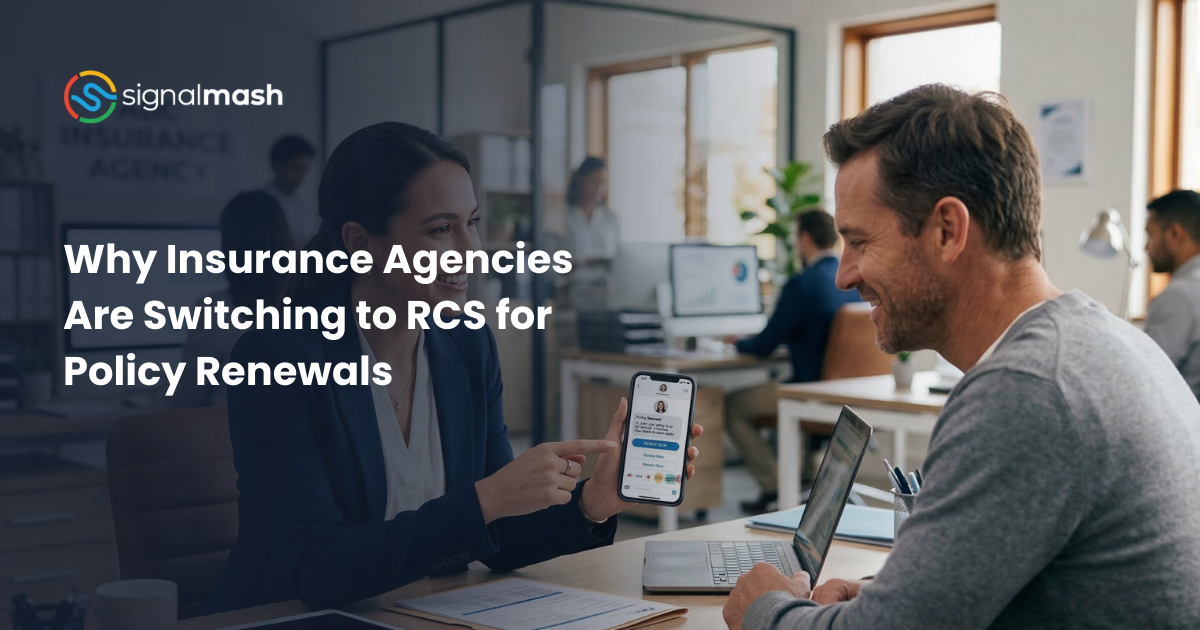
RCS business messaging offers a different approach. Instead of a plain email or a phone call that goes to voicemail, imagine sending a branded message that arrives in the policyholder's native texting app. It shows your agency's name and logo with a verification badge. Below that, a rich card displaying the policy name, renewal date, premium amount, and two buttons: "Renew Now" and "Talk to My Agent."
One tap to renew. No email to find. No phone call to return. No friction.
Why Traditional Renewal Communication Fails
Insurance is a relationship business that increasingly uses impersonal communication channels to manage the most important touchpoints. Renewal season exposes this mismatch.
Email fatigue
Your policyholders receive dozens of emails daily. Your renewal reminder competes with promotional offers, newsletters, social notifications, and actual correspondence. Even well-designed renewal emails get lost. And if your email ends up in the Promotions tab or the spam folder, it never gets seen at all.
Phone avoidance
Younger policyholders increasingly screen calls from unknown numbers. Older policyholders are more likely to answer, but the time cost of phone-based renewals is unsustainable for agencies with hundreds of renewals per month. Every minute your CSR spends on a renewal call is a minute not spent on sales, service, or relationship building.
SMS limitations
Some agencies use SMS for renewal reminders, and it performs better than email. But a 160-character text cannot show policy details, cannot display your agency brand, and cannot include a one-tap renewal button. The customer reads "Your auto policy renews on March 15" and then has to navigate to a website, find their policy, and complete the process manually.
What RCS Changes for Insurance Communication
RCS sits between basic SMS and a mobile app, offering the rich visual experience of an app inside the native messaging app that every smartphone user already has.
Verified Sender Identity
Every RCS message from your agency arrives with your business name, logo, and a carrier-verified badge. In an industry where phishing and impersonation scams target insurance customers regularly, this verified identity is not just a branding feature. It is a trust signal that directly affects whether the policyholder engages with your message.
When a customer sees a text from an unknown number about their insurance policy, their first instinct is suspicion. When they see your agency's name and logo with a verification badge, their instinct is recognition. That shift in perception changes engagement rates dramatically.
Rich Cards for Policy Information
A rich card displays structured information with visual elements. For insurance renewals, this means showing the policy type, policyholder name, renewal date, premium amount, and action buttons in a single, clean message. The policyholder sees everything they need to make a decision without navigating away from their messaging app.
Compare this to an email that requires opening, scrolling, finding the renewal button, clicking through to a portal, logging in, and then completing the renewal. Each step loses a percentage of policyholders. The RCS rich card compresses that journey to a single tap.
Carousel Messages for Multi-Policy Households
Many policyholders have multiple policies with the same agency: auto, home, umbrella, and possibly life or business. A carousel lets you display each policy as a separate card that the customer swipes through, each with its own renewal status and action button.
Instead of sending four separate renewal emails or making four separate phone calls, you send one carousel message that covers the entire relationship. The customer renews each policy with a tap, directly from the message thread.
Practical RCS Use Cases for Insurance Agencies
| Use Case | What the RCS Message Looks Like | Business Impact |
|---|---|---|
| Policy Renewal | Rich card with policy name, premium, renewal date, and Renew Now button | Reduces phone-based renewals and enables faster payment collection |
| Claims Status Updates | Timeline card showing claim stages with the current status highlighted | Reduces inbound “Where is my claim?” calls by 40–60% |
| Payment Reminders | Card showing amount due, due date, and Pay Now button linked to payment portal | Fewer lapsed policies caused by missed payments |
| New Policy Welcome | Branded welcome card with ID card image, agent contact, and portal link | Creates a professional first interaction with the customer |
| Annual Review Scheduling | Card with suggested appointment times and one-tap booking buttons | Higher annual review completion rates than phone invitations |
| Document Requests | Card describing required documents with Upload button linked to a secure portal | Faster underwriting due to quicker document collection |
The Claims Communication Advantage
Claims processing is where most policyholder frustration builds. The customer filed a claim, and now they wait. They call for updates and get voicemail. They email and get an auto-reply. The anxiety of not knowing where their claim stands turns a stressful situation into a negative experience with your agency.
RCS allows you to send proactive claims status updates that visually show the claim's progress. A timeline-style rich card can display stages like "Claim Filed," "Under Review," "Adjuster Assigned," "Estimate Approved," and "Payment Issued," with the current stage highlighted.
The policyholder sees exactly where their claim stands without calling. This proactive communication reduces inbound service calls, improves customer satisfaction, and frees your CSR team to handle the interactions that actually require human judgment.
Getting Started: A Practical Timeline for Agencies
Month 1: Start the RCS carrier approval process. Approval takes 8 to 16 weeks, so beginning now means you could be live by mid-year. Simultaneously, evaluate which renewal and claims communication flows would benefit most from rich messaging.
Month 2: Design your first RCS messages using a visual builder like Signalmash RCS Studio. Create templates for policy renewal cards, claims status updates, and payment reminders. Preview them on simulated devices and get feedback from your CSR team.
Month 3-4: Launch a pilot with a subset of policyholders. Start with renewal reminders for one policy type and measure the results against your email and phone baseline. Track renewal completion rates, time-to-renewal, and policyholder feedback.
Month 5+: Expand to additional use cases based on pilot results. Add claims status updates, payment reminders, and multi-policy carousels. Roll out across your full policyholder base.
Why Independent Agencies Have the Advantage
Large carriers will eventually adopt RCS for all policyholder communications. But large carriers move slowly. Their IT projects take quarters. Their compliance reviews take months. Their organizational decision-making involves dozens of stakeholders.
Independent agencies can move in weeks. You do not need corporate IT approval. You do not need a board-level technology decision. You need a CPaaS provider that handles the carrier approval, a visual builder that your team can use without coding, and the willingness to try a new communication channel before your competitors do.
Signalmash's RCS Studio is designed for exactly this scenario. Your marketing or operations team designs the messages. The platform handles the carrier integration and SMS fallback. Your Signalmash team provides hands-on support through setup and launch.
The agencies that adopt RCS in 2026 will set the standard for how their market communicates with policyholders. The ones that wait will be implementing a baseline expectation instead of a competitive advantage.
Tags:
RCS
Business
Communications
Customer Experience
Text Messaging

Hi! I’m one of The Mashers at Signalmash
If you want to discuss your SMS & voice needs, we’re available! Use the form below to leave your details or set a 15 min call.