
Date:
April 3, 2026
Category:
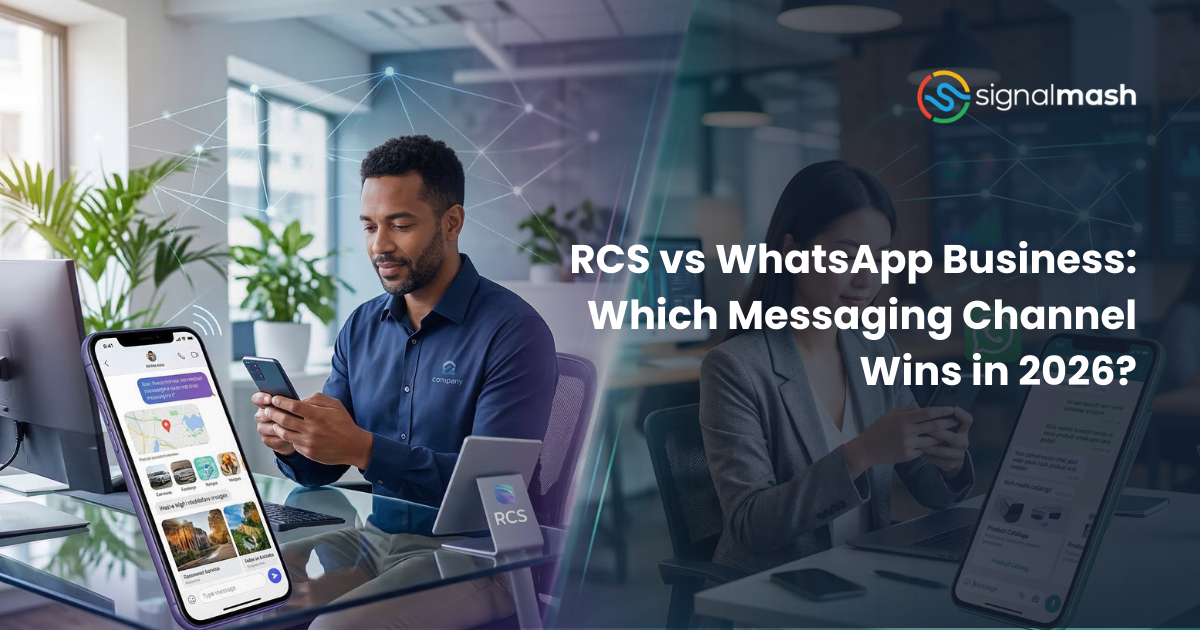
RCS vs WhatsApp Business: Which Messaging Channel Wins in 2026?
Your marketing team is debating two messaging channels. On one side, someone argues for WhatsApp Business because it has 2 billion global users and already runs rich interactive campaigns in Europe, Latin America, and Southeast Asia. On the other side, someone argues for RCS because it lives in the native messaging app, requires no app download, and just gained iPhone support through iOS 18.
Both sides have valid points. And both sides are making the mistake of treating this as an either-or decision without first asking where your customers actually are and what they actually expect.
This comparison breaks down RCS and WhatsApp Business across the dimensions that matter for US-focused businesses: reach, user experience, pricing, compliance, and practical implementation.
The Fundamental Difference: Native vs App-Based
RCS is a protocol built into the default messaging app on smartphones. When your customer receives an RCS message, it shows up in the same Messages app they use for every other text. There is no app to install, no account to create, no login required. If their phone supports RCS, the message just arrives as a rich experience instead of plain SMS.
WhatsApp Business requires the recipient to have WhatsApp installed on their phone. Globally, WhatsApp has over 2 billion users, which makes this a non-issue in most markets outside the US. But in the United States, WhatsApp penetration sits around 30 to 35 percent of smartphone users. That means 65 to 70 percent of your US customers would need to download an app before they can receive your messages.
For US-focused businesses, this is the single most important factor in the comparison. RCS reaches customers in the messaging app they already use. WhatsApp requires them to use a specific app that many Americans do not have installed.
Feature Comparison
| Feature | RCS | WhatsApp Business |
|---|---|---|
| Rich Media | Images, video, audio, files | Images, video, audio, documents, location |
| Interactive Elements | Buttons, carousels, suggested replies | Buttons, lists, quick replies, flows |
| Verified Sender | Carrier-verified brand profile with badge | Meta-verified business profile with green checkmark |
| End-to-End Encryption | Not by default (carrier-level encryption) | Yes, by default for all messages |
| App Required | No (native messaging app) | Yes (WhatsApp must be installed) |
| US Reach | Majority of smartphones (iOS 18 + Android) | Approximately 30–35% of smartphone users |
| Global Reach | Growing, carrier-dependent | 2+ billion users across 180 countries |
| Fallback | Automatic SMS fallback | No native fallback (separate SMS required) |
| Pricing Model | Per-message, varies by carrier | Per-conversation (24-hour session windows) |
| Approval Timeline | 8–16 weeks carrier approval | Days to weeks via BSP |
Where RCS Wins for US Businesses
No app download barrier
This is the decisive advantage for US markets. Your customer does not need to install anything. Your message arrives in the same place their texts from friends and family arrive. The friction reduction between "install WhatsApp and find our business" versus "receive a message in your existing texting app" is enormous, and it directly affects your reach and engagement rates.
Automatic SMS fallback
When a recipient's device does not support RCS, the message automatically falls back to SMS. Your campaign reaches 100 percent of your audience, with RCS-capable devices getting the rich experience and everyone else getting a plain text version. WhatsApp has no equivalent fallback. If someone does not have WhatsApp, they do not get your message at all.
Carrier-level trust signals
RCS sender verification happens through the carrier network. The verified badge on your RCS messages carries carrier authority, which is a strong trust signal for customers who are wary of scams. WhatsApp's green checkmark is Meta-issued, which carries different trust associations depending on the customer.
iPhone support since iOS 18
Apple's addition of RCS in iOS 18 eliminated the biggest historical limitation of RCS. With iOS adoption of RCS growing steadily and the majority of Android devices already supporting it, RCS reach in the US now covers a substantial majority of smartphone users.
Where WhatsApp Business Wins
Global reach outside the US
If your business operates in Latin America, Europe, India, Southeast Asia, or Africa, WhatsApp is often the primary communication channel. In Brazil, India, and Indonesia, WhatsApp penetration exceeds 90 percent. For global businesses, WhatsApp coverage in international markets is unmatched.
End-to-end encryption by default
WhatsApp encrypts all messages end-to-end, meaning not even Meta can read message content in transit. For businesses in industries with strict data privacy requirements, this encryption model offers a compliance advantage that RCS does not currently match.
Conversational commerce maturity
WhatsApp has years of head start building commerce features. WhatsApp Flows allow businesses to create multi-step interactive experiences like product catalogs, payment processing, and lead qualification forms directly within the chat. RCS interactive elements are strong but not yet as deep.
Faster approval process
Getting approved for WhatsApp Business messaging typically takes days to a few weeks through a Business Solution Provider. RCS carrier approval currently runs 8 to 16 weeks. For businesses that need to launch quickly, WhatsApp has a time-to-market advantage.
The US Market Reality: Why RCS Usually Wins Here
For businesses whose customers are primarily in the United States, RCS holds the stronger position. The math is straightforward.
RCS reaches the majority of US smartphone users through the native messaging app. WhatsApp reaches roughly a third. If your goal is to send a rich, interactive message to an American customer, RCS is more likely to succeed because it does not require the customer to have installed a specific app.
The automatic SMS fallback also means your RCS campaigns are low-risk. You design a rich message, and if the recipient cannot receive RCS, they get an SMS instead. You never miss a customer. With WhatsApp, a customer without the app is simply unreachable through that channel.
WhatsApp makes sense for US businesses in specific scenarios: if your customer base has high WhatsApp adoption (common in immigrant communities and among younger demographics who use WhatsApp for international communication), or if your business operates across multiple countries and needs a unified global messaging strategy.
Can You Run Both Channels?
Yes, and some businesses will eventually do exactly that. RCS for domestic US messaging with SMS fallback, and WhatsApp for international markets or specific customer segments.
The practical challenge is managing two rich messaging channels with different approval processes, different message formats, different analytics, and different compliance requirements. For most SMBs, starting with one channel and executing it well is more productive than splitting resources across two.
If your customers are primarily in the US, start with RCS. If your customers are global, evaluate WhatsApp for international markets and RCS for domestic. If you are unsure, RCS with SMS fallback gives you the broadest US coverage with the least complexity.
How to Get Started with RCS
If you have decided that RCS is the right channel for your business, the first step is starting the carrier approval process. Because approval takes 8 to 16 weeks, early action translates directly to earlier launch dates.
Signalmash handles the RCS carrier approval process alongside you and provides RCS Studio, a visual campaign builder where your marketing team can design rich messages without code. You can build and preview your campaigns while waiting for approval, so you are ready to send the day you go live.
The businesses that will benefit most from RCS are the ones that start now, while the channel is still early enough to stand out and before every competitor in your industry is sending the same kind of rich interactive messages.
Tags:
RCS
Business
Communications

Hi! I’m one of The Mashers at Signalmash
If you want to discuss your SMS & voice needs, we’re available! Use the form below to leave your details or set a 15 min call.