

.png)
The Communication Infrastructure Your Business Actually Needs
SMS services offer a highly efficient way for brands to reach out and build more personable relationships with their customers. 77% of consumers see businesses that use texting to send product updates, appointment reminders, and other updates in a better light than those that don't.
Mobile users in the U.S. sent 2.2 trillion SMS or MMS messages in 2020, up from 1.5 trillion messages in 2017. The rise of mobile messaging has made text communication essential for modern business operations.
If you want to send text messages but don't know where to start, this comprehensive guide will walk you through everything you need to know about SMS APIs, short codes, and long codes to make informed decisions for your business.
Important Regulatory Note: In America, there are strict regulations on how businesses should interact with customers via SMS. Sending an SMS incorrectly can result in a discontinuation of your service and/or a fine of up to $1,500 per message. Contact our experts for further information on the regulatory restrictions.
Understanding SMS APIs: The Foundation of Modern Business Messaging
Today, nearly 90% of developers use APIs because they're effective at getting things done faster and at a higher return on investment. But what exactly is an SMS API, and why does your business need one?
What Is an API?
An API (Application Programming Interface) is a set of functions that allows applications to access data and interact with external software components, operating systems, or microservices. Simply put, it is the messenger that delivers your request to the provider that you're requesting it from and then brings a response back to you. Essentially, it works as a middleman, allowing developers to build new programmatic interactions between their applications.
For example, The USPS Web Tools® API library gives ecommerce website shopping carts and shipping software access to valuable USPS® data. You can check shipping rates, track packages, and schedule a package pickup through USPS Web Tools. It is free of charge.
SMS API Defined
The great thing is that an API can be used for communications like text messaging and programmatic voice. Short Message Service (SMS) API is a communications interface which allows code to send short messages via a SMS Gateway. It enables text messaging through web frameworks. Therefore, it connects your app to users without carrier difficulties. It allows you to send and receive text messages within your existing web or mobile app.
How Does an SMS API Work?
An SMS API uses requests to send and receive data from a server. CPaaS providers like Signalmash, Twilio, or Plivo offer an SMS API. Once you have an account with a CPaaS provider, you can purchase a phone number(s) and configure your application to use the provider's API. With the API, you can send and receive text messages to your customers from your existing application.
An SMS API provides a link between your app and the communications platform, enabling you to communicate with customers by SMS and phone. By using a CPaaS platform, you don't have to spend a lot of money on building a complex communications infrastructure.
The Benefits of Using an SMS API
There are many benefits of using an SMS API for business communications. Understanding these advantages helps explain why text messaging has become central to customer engagement strategies:
Centralizes Your Customer Experience
All communications are handled within your application rather than in several different applications. This unified approach means your team doesn't need to switch between platforms to manage customer interactions.
Seamless Integration
An SMS API can be easily integrated into your existing application. This allows you to quickly add SMS functionality to your app without developing a communications infrastructure from scratch. Most modern APIs provide clear documentation and simple setup processes that developers can implement in hours, not weeks.
Cost-Effective Communication
Using SMS to communicate with customers, vendors, and other business contacts costs less than older methods of communications, both for the company and for the environment. Compared to phone calls, direct mail, or traditional advertising, SMS delivers messages at a fraction of the cost.
Flexible and Scalable
You can easily scale your SMS communications to meet your changing business needs. Whether you're sending 100 messages or 100,000, the infrastructure adapts automatically without requiring additional setup or investment.
Convenient for Customers
SMS communications is convenient for customers. Texts can be easily accessed and responded to from your customers' own mobile devices. And customer inquiries can be answered in real-time, creating immediate engagement opportunities.
Improved Customer Service
You can provide better customer service by quickly and easily sending essential updates, notifications, and other informative text messages to customers. This proactive communication reduces support volume while increasing customer satisfaction.
How Businesses Use SMS APIs
Any business that requires consistent, streamlined text communications with its clientele is a candidate for SMS API use. From restaurants to schools, airlines, retail stores, banks, and government agencies, practically all organizations can benefit from an SMS API.
The power of an SMS API is in the versatility. The following are some of the most effective ways businesses incorporate an SMS API into their existing software or application:
Sending Appointment Reminders
With an SMS API, you can send appointment reminders to customers via your software. This allows companies to reduce no-shows and missed appointments. Healthcare providers, salons, service companies, and professional offices use this feature to maintain schedules and reduce lost revenue from forgotten appointments.
Confirming Reservations
You can confirm reservations with customers via your app by sending an SMS. This ensures no misunderstandings about bookings and keeps customers updated on their reservation status. Hotels, restaurants, and event venues rely on SMS confirmations to reduce confusion and improve the customer experience.
Notifying Customers of Cancellations or Changes
You can notify customers of cancellations or changes to their orders, flights, or other arrangements via SMS. This keeps customers informed and prevents them from being stranded or losing out on important information. Airlines, shipping companies, and service providers use real-time notifications to maintain trust during disruptions.
Sending Special Offers and Coupons
You can send special offers and coupons to customers through your app via SMS. This encourages customer loyalty and can result in increased sales. Retail stores, restaurants, and e-commerce platforms use targeted promotions to drive immediate purchasing decisions.
Communicating About Account Status or Issues
You can communicate by text with customers about their account status or any other issues they may be experiencing. This allows businesses to address and resolve any customer service problems quickly. Banks, subscription services, and utilities use SMS to keep customers informed about important account matters.
Sending Marketing or Promotional Messages
You can send out marketing or promotional messages to customers through your software. This helps businesses keep in touch with their clientele and promote new products or services. When done compliantly with proper opt-in procedures, SMS marketing delivers exceptional engagement rates.
Understanding Short Codes and Long Codes
Now that you understand how SMS APIs work, you need to know about the two types of phone numbers used for business texting: short codes and long codes. Each has its own characteristics, use cases, and regulatory requirements.
What Is an SMS Short Code?
Short codes are used to send SMS messages, and they are typically five or six digits in length. Unlike traditional phone numbers, short codes are designed specifically for high-volume, one-way messaging from businesses to consumers.
Examples of short codes:
- 78941
- 24680
- 555123
Common short code use cases:
- Two-factor authentication (2FA)
- Payment reminders
- Appointment alerts
- Discount coupons
- News alerts
- Marketing campaigns
If you are sending a large quantity of messages (i.e., a marketing campaign to all your customers), your messages have the potential to be blocked as spam. Using short codes, as opposed to long codes, lessens the risk of being marked as spam. The main reason is that a business must first register its use case and get vetted to send messages from a short code. This process can take 8-12 weeks.
The vetting process involves approval from the CTIA (Cellular Telecommunications Industry Association) and requires detailed documentation about your messaging program. While the setup time is longer, this thorough review process gives short codes higher trust scores with carriers, resulting in better deliverability and higher throughput.
What Is an SMS Long Code?
Long codes, also known as long virtual numbers (LVNs) or long numbers, are 10 or 11 digits in length and designated by mobile operators for peer-to-peer (P2P) communications. They look like regular phone numbers and can be used for both voice calls and two-way texting.
Examples of long codes:
- 415-656-1000
- 202-555-0143
- 312-867-5309
Long codes were originally designed for P2P communications, not for mass texting. In early 2021, companies could start to apply for 10DLC (10-digit long code) for A2P (Application-to-Person) messaging. The process is faster than short code registration, and generally you can start sending text messages from long numbers in 2-3 weeks.
Common long code use cases:
- Customer service communications
- Two-way conversational messaging
- Anonymous dating apps
- Chat applications
- Direct response interactions
- Local business texting
Short Code vs. Long Code: A Detailed Comparison
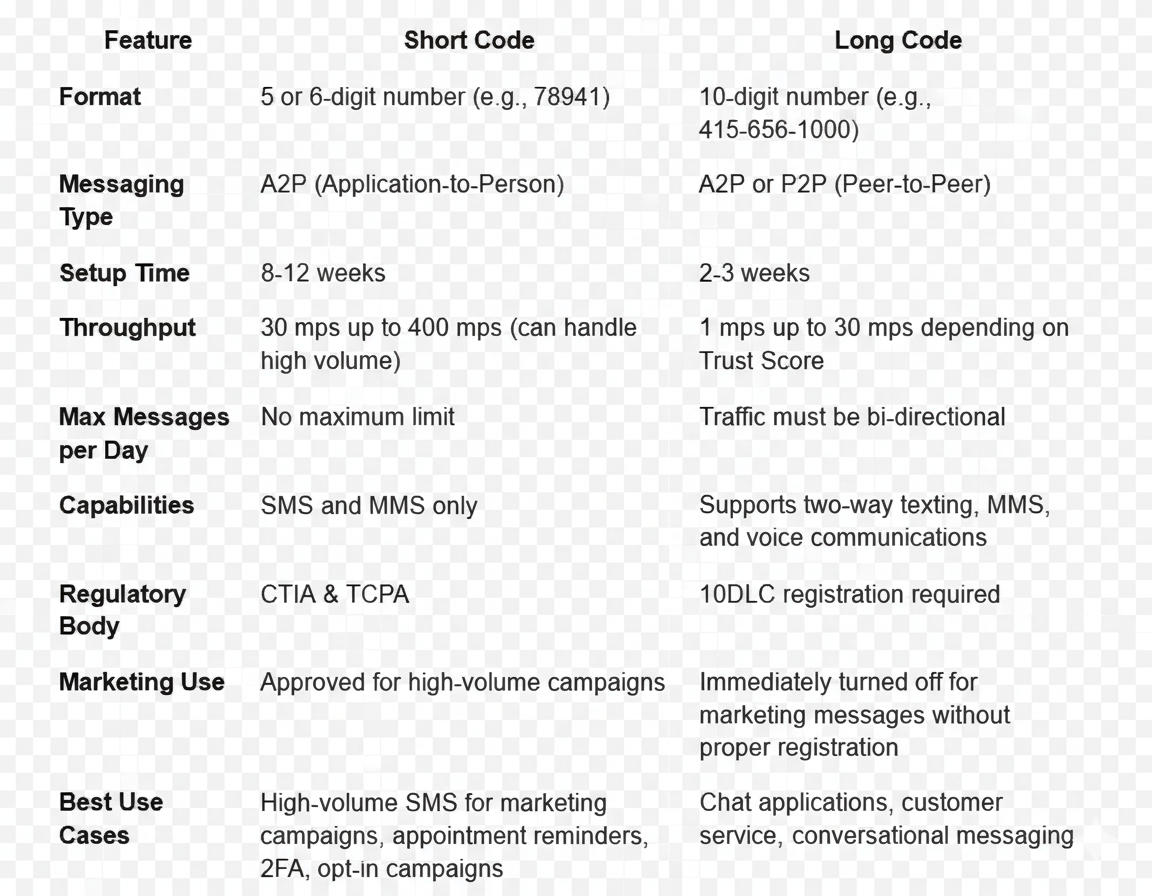
Understanding the differences between short codes and long codes helps you choose the right option for your specific business needs.
Cost Considerations
Short codes typically cost more to lease (ranging from $500 to $1,000 per month), but their high throughput and superior deliverability make them cost-effective for high-volume sending. Long codes are cheaper to acquire and maintain, making them ideal for businesses with moderate messaging needs or those focusing on two-way communication.
Deliverability Differences
Short codes generally have higher deliverability rates because of the thorough vetting process and carrier approval. Long codes can face more filtering, especially when sending high volumes, unless properly registered through 10DLC programs with strong trust scores.
User Perception
Short codes are instantly recognizable as business communications, which can be both an advantage and disadvantage depending on your goals. Long codes appear more personal, like messages from a real person, which can improve engagement in certain contexts but may also raise questions about legitimacy if users don't recognize the number.
Choosing Between Short Code and Long Code
Sending text messages is an effective way to connect to customers and prospective customers. The type of number you send from will depend on how large your audience is, the frequency with which you send messages, how fast they need to be sent, and what your budget is.
Choose Short Codes When:
- You're sending high-volume A2P messaging campaigns
- Time-sensitive messages need to reach large audiences quickly
- You're running marketing campaigns to thousands of recipients
- You need to send more than 30 messages per second
- Deliverability is critical and worth the investment
- You have 8-12 weeks for setup and approval
- You're running SMS voting, contests, or sweepstakes
- You need maximum carrier trust and minimal filtering
Short codes deliver SMS at an average rate of 100 mps (message segments per second), which is ideal to send time-sensitive messages to a large number of users at once.
Choose Long Codes When:
- You're focused on two-way interpersonal communication
- Your messaging volume is moderate (under 30 messages per second)
- You need voice calling capabilities in addition to texting
- You want a faster setup time (2-3 weeks)
- Your budget is limited and you need lower monthly costs
- You're providing customer service through conversational messaging
- Local presence matters for your business
- You want a number that looks like a regular phone number
Long codes are ideal for two-way interpersonal communication, such as phone conversations and standard text messages. Service companies have traditionally utilized ten-digit numbers for communicating rather than marketing campaigns, but 10DLC has altered that. Also, long codes are more widely available and the setup time is shorter.
The Hybrid Approach
Many businesses use both short codes and long codes strategically. For example, a retail company might use a short code for promotional campaigns and a long code for customer service inquiries. This approach maximizes the strengths of each number type while managing costs effectively.
How to Choose the Right SMS Provider
SMS APIs are quickly becoming a staple in business communications. If you need a reliable, cost-effective way to communicate with your customers, it is time to find a CPaaS provider. When choosing a provider, here are a few things to keep in mind:
Cost-Effectiveness
The cost should match the functionality and options. You shouldn't pay for features you aren't using. Transparent pricing models that scale with your actual usage provide the best value. Watch out for hidden fees, minimum commitments, or charges for features you don't need.
Flexibility
The provider should offer flexible plans to match your specific business needs. Whether you need short codes, long codes, or both, the platform should support your current requirements without locking you into unnecessary services.
Scalability
The provider should provide options that are built to scale as your company grows and needs different features. Your SMS infrastructure should expand seamlessly as your message volume increases, without requiring platform migrations or major reconfiguration.
Easy to Use
The provider's platform should be easy to use, making it quick and easy to get started. Clear documentation, intuitive APIs, and straightforward setup processes save development time and reduce implementation errors.
Support Quality
The provider should offer excellent customer support, ensuring that you have the help you need when using their API. Ideally, this service shouldn't be an extra charge. Look for providers that offer responsive support during business hours through multiple channels like chat, email, and phone.
Compliance Expertise
The provider should stay current with ever-changing industry landscapes, regulations, and protocols. TCPA compliance, 10DLC registration support, and carrier relationship management should be handled proactively to prevent deliverability issues.
Infrastructure Reliability
Uptime guarantees, redundant systems, and transparent status reporting indicate a provider that takes reliability seriously. When your business depends on message delivery, infrastructure quality matters more than features.
Signalmash: Your Partner in Business Messaging
Choosing the right provider can make a big difference in the success of your business communications. With the right CPaaS provider, you can easily automate your customer interactions and take your business to the next level.
Why Choose Signalmash?
Simple, Powerful API Integration
Use Signalmash to transform your business communications. Send and receive SMS messages by incorporating our API into your existing application. We have detailed documentation for developers so you can set up and start sending text messages in minutes.
Comprehensive Support
Our support team is on standby to help you every step of the way. Unlike providers that charge extra for support or limit access based on spending tiers, Signalmash provides responsive assistance to all customers.
Regulatory Compliance Management
Most importantly, we keep up with ever-changing industry landscapes, regulations, and protocols. Our team handles the complexity of CTIA guidelines, TCPA requirements, and carrier relationships so you can focus on your messaging strategy.
Short Code and Long Code Solutions
Whether you need high-volume short codes for marketing campaigns or long codes for customer service, Signalmash provides both options with transparent pricing and fast setup.
Reliable Performance
Signalmash can take care of all your messaging needs. With our platform, you'll be able to send and receive text messages quickly and easily, with low latency and high delivery rates.
Cost Efficiency
We are like Twilio without the fluff. We focus on the functions that really matter and don't compete against our customers. Ask us how you can cut your Twilio or CPaaS bill up to 50%!
Getting Started
Ready to implement SMS messaging in your business? Here's how to begin:
- Assess your needs: Determine your message volume, use cases, and whether you need short codes, long codes, or both.
- Contact Signalmash: Reach out to our team to discuss your specific requirements and get guidance on the best approach for your business.
- Set up your account: We'll help you configure your account, register appropriate numbers, and ensure compliance with all regulations.
- Integrate the API: Our detailed documentation and support team will guide you through integration into your existing applications.
- Launch and scale: Start sending messages and scale your communication as your business grows, with ongoing support every step of the way.
Conclusion
SMS messaging has evolved from a consumer technology into a critical business communication channel. Understanding SMS APIs, short codes, and long codes gives you the knowledge to implement effective text messaging strategies that improve customer engagement, reduce operational costs, and scale with your business growth.
The right combination of technology (SMS APIs), infrastructure (short codes or long codes), and partner (a reliable CPaaS provider) creates a communication system that works seamlessly in the background while delivering measurable business results.
Don't let complex telecommunications infrastructure hold back your customer communication strategy. With modern SMS APIs and the right provider, you can implement professional-grade text messaging in days, not months.
Ready to transform your business communications with SMS? Reach out to Signalmash today. Let us show you how quickly you can start sending SMS messages through our messaging API. Ask us how you can cut your Twilio or CPaaS bill up to 50%!
Book a call with our team to get started.