

.png)
The Problem Statement
A Chime customer gets a text: "Unusual activity detected on your account. Tap here to verify your identity." The message looks exactly like the phishing texts they have seen warnings about. So they ignore it or worse, they call customer support to ask if it is real.
The painful part? That message was from Chime.
This is not an edge case. It is a daily operational reality for consumer neobanks, digital wallets, and crypto platforms across the US. The security notification designed to protect a customer is actively eroding their trust in your brand because on SMS, your fraud alert looks identical to a scammer's attempt to steal their credentials.
Why Fintech Is the Highest-Value Target for SMS Phishing
Financial services companies receive more SMS phishing impersonation attempts than any other industry. The reason is straightforward: mobile-first fintech users are trained to interact with their accounts via text. They expect OTPs, fraud alerts, and payment confirmations through SMS. Scammers know this, and they replicate the pattern precisely.
According to the FTC, impersonation scams including those mimicking financial brands accounted for billions in consumer losses annually. For neobanks specifically, the stakes are compounded by the fact that their entire product experience is digital. There is no branch to walk into. Text messages are a primary trust signal.
When that trust signal gets corrupted by impersonators and your real messages become indistinguishable from scam texts you have a product problem, not just a security problem.
What SMS Cannot Fix
The structural issue with SMS is that it carries no sender verification at the network level. A message arriving in a customer's inbox with your short code or long number can be spoofed. The message looks identical whether it comes from your infrastructure or a fraudster's server overseas.
Fintechs have tried workarounds. Branded short codes help with recognition but do not authenticate. "This is [Brand]. We will never ask for your password" footers are ignored. Customer education campaigns have limited shelf life; you cannot run a trust awareness campaign every quarter and expect it to stick.
The problem is not customer awareness. The problem is that SMS was never built to authenticate senders.
How RCS Verified Sender Works And Why It Is Different
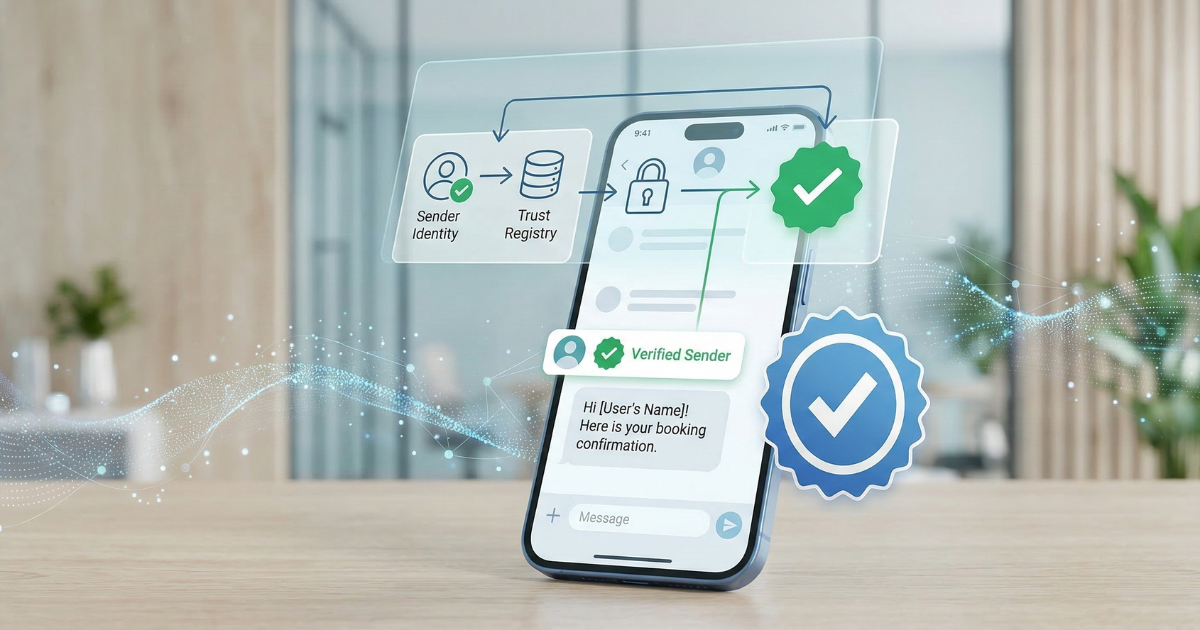
RCS (Rich Communication Services) builds sender verification into the message itself, at the carrier level. When a business sends an RCS message, the carrier verifies the brand identity before the message reaches the customer's phone. The result: your brand name, logo, and a verified checkmark appear in the message thread. Cryptographically authenticated, not a visual design trick.
From the customer's perspective, the difference is visible and immediate. Instead of an anonymous number with a suspicious link, they see your verified company logo, your brand name confirmed by the carrier, and a clear visual distinction between your legitimate message and any spoofed attempt.
For a fintech whose customers have been trained to distrust financial texts, this is the only fix that works at the infrastructure layer. You are not asking customers to be more sophisticated. You are making it structurally impossible for a scammer to convincingly impersonate your brand in the same channel.
The Downstream Impact Fintechs Do Not Always Track
Customer support call volume spikes after every legitimate fraud alert SMS campaign. Customers call to verify whether the text was real. That is an avoidable support cost but only if the message is identifiably authentic.
Action completion rates on fraud verification flows drop because customers hesitate to tap a link in a text. You might have 90% open rates on your fraud alert. But if only 40% actually complete the verification step because they are unsure the message is real, your fraud prevention pipeline has a trust-driven leak.
NPS scores take a hit when customers feel anxiety instead of confidence from your security notifications. The message meant to reassure them creates friction instead.
What This Looks Like in Practice: RCS Fraud Alert vs SMS Fraud Alert
On SMS: "CHIME: Unusual activity on your account. Tap https://bit.ly/3xyzABC to verify. Reply STOP to opt out."
On RCS with verified sender: The customer sees the Chime logo, "Chime Financial" in the sender name with a carrier-verified badge, a structured message card showing the specific transaction flagged, and two action buttons "This Was Me" and "Report Fraud" built directly into the message.
No link to tap and second-guess. No short code to wonder about. The customer knows it is real, acts immediately, and your fraud prevention flow completes.
The Implementation Reality for Engineering Teams
One concern that comes up in technical evaluations: does moving to RCS require rebuilding messaging infrastructure? For most fintech engineering teams that have already built on a CPaaS stack, the answer is no.
RCS can be added as a channel alongside existing SMS infrastructure. The API endpoint changes. The message construction adds structured content. But the logic of when to send, who to send to, and how to handle opt-outs maps directly onto your existing messaging code.
Where teams run into friction is building and testing new RCS message templates. That is where an RCS Studio, a no-code campaign builder becomes operationally relevant.
Your growth or CX team can build and iterate RCS message designs without putting it in the engineering backlog. Engineering does the initial integration once. Operations runs campaigns independently from that point forward.
Compliance Considerations for Fintech Messaging
Fintech security and compliance teams will ask specific questions before approving an RCS vendor: SOC-II status, customer data handling in transit and at rest, TCPA opt-out handling for RCS messages, and automatic SMS fallback for non-RCS devices.
RCS with an enterprise-grade provider should have clean answers to all of them. SOC-II Type II certification, clear data handling documentation, built-in TCPA compliance, and automatic SMS fallback should all be standard not afterthoughts for any fintech considering this channel.
The Timing Argument
Most consumer neobanks, crypto platforms, and digital wallets in the US are still entirely on SMS for security messaging. RCS adoption in financial services is in its early stages which means the brand differentiation opportunity is real and time-limited.
A neobank whose fraud alerts show up with verified branding, structured message cards, and in-message action buttons looks meaningfully more trustworthy than a competitor whose alerts look like the phishing texts customers get twice a week. That differentiation drives NPS and reduces churn at the margin.
The window to be an early mover in RCS for fraud and security messaging in fintech is open right now. It will not stay open indefinitely.