

Date:
April 24, 2026
Category:
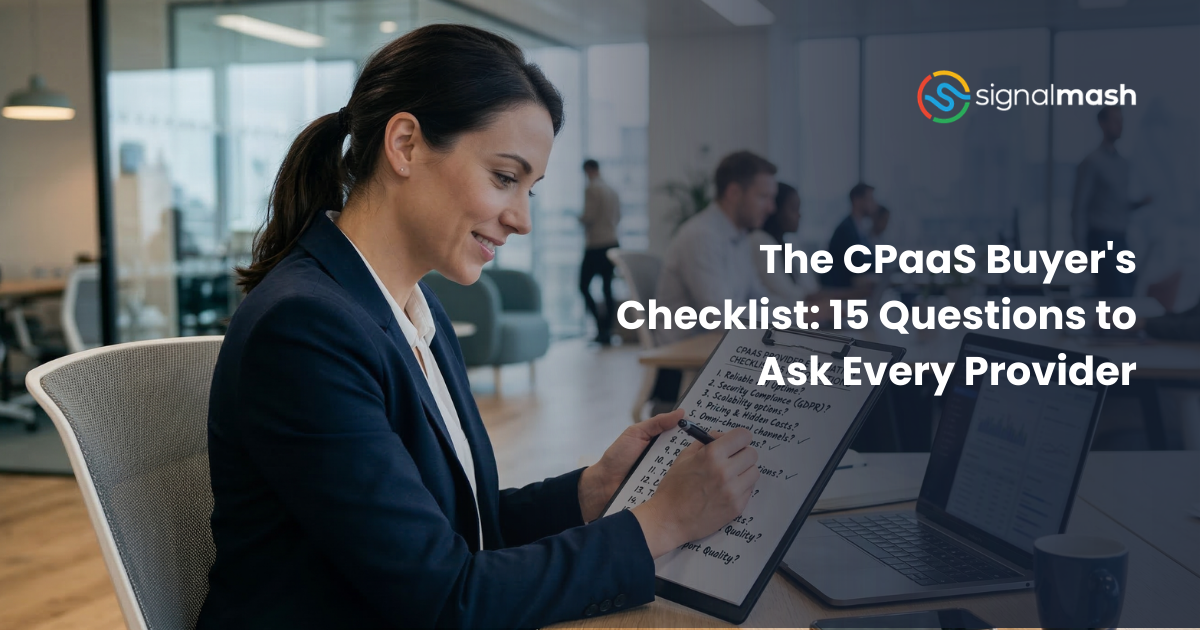
The CPaaS Buyer's Checklist: 15 Questions to Ask Every Provider
You are about to choose a CPaaS provider, and every vendor on your shortlist sounds the same. Reliable delivery. Developer-friendly APIs. Competitive pricing. Great support. The marketing pages are polished, the case studies are impressive, and the sales reps are confident.
But somewhere between the demo and the signed contract, most businesses stop asking the questions that actually determine whether the provider fits their needs. They compare feature lists instead of asking about real-world support response times. They look at published per-message rates instead of asking about the total cost after surcharges. They sign up without understanding what happens when something goes wrong.
These 15 questions cut through the marketing language and get to the information that matters. Print this list, bring it to your next vendor evaluation, and compare the answers side by side.
Pricing and Billing
1. What is my total cost per message, including all surcharges and fees?
The published per-message rate is never the full story. Ask for a complete breakdown: base rate, carrier surcharges (AT&T, T-Mobile, Verizon each charge different amounts), 10DLC fees, segment charges for long messages, MMS premiums, and inbound message costs. Then ask them to calculate your estimated monthly total based on your actual volume.
If the provider cannot give you a clear total, that tells you something about how your invoices will look.
2. Does your pricing change as my volume grows?
Some providers offer volume discounts. Others have pricing that stays flat or even increases with certain surcharges at higher volumes. Ask specifically: if my volume doubles next quarter, what happens to my per-message cost? Is there a committed volume threshold I need to hit for discounted rates? What happens if I exceed my commitment?
3. Do you offer flat-rate pricing?
If budget predictability is important to your business, ask whether the provider offers a flat monthly rate that covers your messaging and voice usage. Signalmash's flat-rate model eliminates the variable billing that makes CPaaS costs difficult to forecast. Not every provider offers this option, and it is worth knowing upfront.
Support and Service
4. What does your standard support include, and what costs extra?
This is the question that reveals the most about a provider's priorities. Some providers include documentation and community forums at the base tier and charge $250 or more per month for human support. Others include dedicated support at all levels.
Ask specifically: if I have a deliverability issue at 2 PM on a Tuesday, who do I contact? How long until I get a response from a real person? Is that timeline guaranteed by an SLA?
5. Will I have a dedicated point of contact?
There is a significant difference between "open a ticket and wait" and "message your dedicated Slack channel." Ask whether you will have a named account manager or engineer who knows your setup, or whether you will interact with a rotating pool of support agents who start from zero on every interaction.
6. What is your average support resolution time?
Not response time. Resolution time. Many providers measure response time (how quickly they acknowledge your ticket) but not resolution time (how quickly the problem is actually fixed). The first number is about optics. The second number is about outcomes.
Compliance and Registration
7. How do you help with 10DLC registration?
The range of answers here is wide. Some providers offer a self-serve dashboard and documentation. Others review your submission before filing, help you write campaign descriptions, and troubleshoot rejections. Ask: do you review my brand and campaign details before submission? If I get rejected, do you help me fix the issue, or do I figure it out myself?
8. What happens if my 10DLC campaign gets suspended?
Campaign suspensions happen, sometimes due to carrier audits, sometimes due to content that drifts from the registered use case. Ask the provider: what is your process for handling suspensions? Do you have direct contacts at the carriers to expedite resolution? How quickly can I expect my campaign to be reinstated?
9. Do you handle toll-free verification and short code approval?
If you use toll-free numbers or short codes, ask about the provider's verification and approval process. Some handle it end to end. Others hand you a form and leave you to manage the process.
Infrastructure and Reliability
10. What carrier connections do you have?
Direct Tier-1 carrier connections deliver better than aggregated routes. Ask whether the provider connects directly to AT&T, Verizon, T-Mobile, and Bandwidth, or whether they route through intermediaries. Direct connections affect both SMS deliverability and voice call quality.
11. What is your uptime SLA and how is it measured?
A 99.99 percent uptime SLA sounds impressive until you learn it excludes scheduled maintenance windows, carrier outages, and API endpoints that are not in your critical path. Ask what the SLA specifically covers, what counts as downtime, and what compensation you receive if the SLA is not met.
12. How do you handle failover and redundancy?
If one carrier route goes down, does the provider automatically reroute your traffic? For voice, do they have geographic redundancy in their SIP infrastructure? For SMS, do they maintain multiple carrier paths so a single carrier issue does not block all your messages?
Product and Features
13. Do you support RCS, and how?
RCS support varies from "we have an API you can integrate" to "we have a visual campaign builder your marketing team can use." If RCS is on your roadmap, ask about the specific implementation. Do you offer a no-code campaign builder? Do you handle carrier approval? Do you manage SMS fallback automatically?
14. Do you support Branded Caller ID?
If your business makes outbound calls, Branded Caller ID displays your name, logo, and call reason on the recipient's screen. Ask whether the provider is an authorized BCID partner, or whether they offer the feature through a third-party integration. Authorized partners typically provide a smoother setup experience.
15. What does migration from my current provider look like?
If you are switching providers, ask about the migration process. Do they handle number porting? How long does it take? Is there a risk of message gaps during the transition? Will they coordinate with your current provider to ensure continuity? Do they help re-register your 10DLC campaigns?
A provider that has helped many businesses migrate will have a clear, tested process. A provider that hesitates or gives vague answers may not have done it before.
How to Use This Checklist
Send these 15 questions to every provider on your shortlist and compare the answers side by side. Pay attention to which providers give specific, concrete answers versus which ones redirect to their website or offer to "circle back."
The providers that answer directly and confidently are the ones that will support you the same way after the contract is signed.
If you want to see how Signalmash answers these questions, reach out for a conversation. They will walk through each one with specifics, not generalities. Flat-rate pricing. Dedicated Slack support. Hands-on 10DLC registration. Direct carrier connections. Authorized BCID partner. No sales pitch required, just honest answers to honest questions.
Tags:
Business
Communications
Text Messaging

Hi! I’m one of The Mashers at Signalmash
If you want to discuss your SMS & voice needs, we’re available! Use the form below to leave your details or set a 15 min call.