

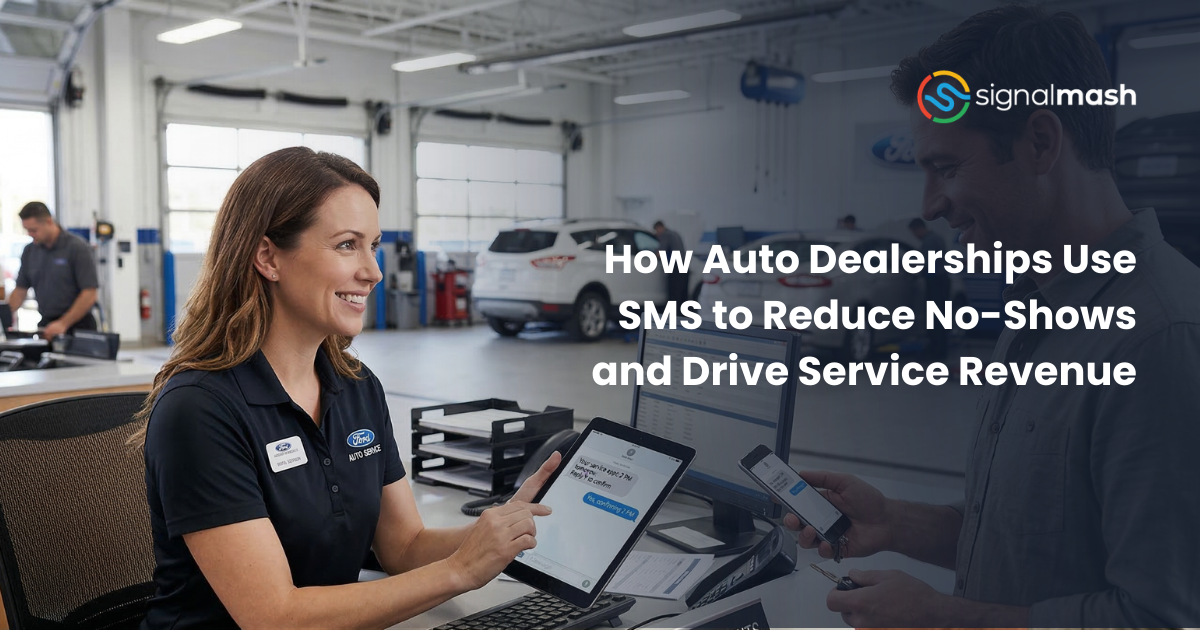
Your service department scheduled 45 appointments today. By noon, 8 customers had not shown up. No call. No text. Just empty bays and idle technicians. That is roughly $2,400 in lost labor revenue before lunch, assuming a $300 average repair order.
Meanwhile, your BDC team has 30 internet leads sitting in the CRM from last night. The first dealership to respond to an internet lead wins 78 percent of the time. But your team does not start calling until 9 AM, and by then, those leads have already heard from three other dealers who responded by text within minutes.
These are not edge cases. No-shows and slow lead response are the two biggest revenue leaks in dealership operations, and both have the same fix: a properly configured SMS messaging program.
Dealerships that implement automated SMS reminders reduce service appointment no-shows by up to 38 percent. Dealers that respond to internet leads via text within 5 minutes close at dramatically higher rates than those who rely on phone calls alone.
The US has approximately 18,000 dealerships, and most are already heavy SMS users for basic communications. But there is a wide gap between sending ad hoc texts from a personal phone and running a compliant, automated SMS program that actually moves the revenue needle.
Why SMS Works Better Than Phone Calls for Dealerships
Dealership customers prefer text messaging, and the data is clear on this point. Open rates for SMS run above 90 percent, and most texts are read within 3 minutes of delivery. Compare that to phone calls, where the average dealership answer rate on outbound calls to service customers is well below 50 percent.
There is a practical reason beyond preference. Your customers are at work. They cannot answer a phone call from an unknown number during a meeting, but they can glance at a text and respond in 10 seconds. A service reminder that says "Your oil change is scheduled for Tuesday at 3 PM. Reply C to confirm or R to reschedule" gets a response. A phone call that goes to voicemail gets forgotten.
For the BDC team handling internet leads, speed matters more than channel in the first response. But text delivers that speed advantage. An automated text fires immediately when a lead submission comes in, while a phone call requires a human to be available, dial the number, and hope the prospect answers. The text arrives while the customer is still on your website.
Service Department SMS: The Revenue Engine
Appointment Reminders That Reduce No-Shows
The single highest-ROI use of SMS in a dealership is automated service appointment reminders. Send a text 48 hours before the appointment, and another on the morning of. Include the date, time, and a simple confirm or reschedule option.
The 38 percent reduction in no-shows is not theoretical. Dealerships that implement two-touch reminder sequences consistently report this level of improvement. On a service department that schedules 40 appointments per day, a 38 percent reduction in no-shows means roughly 3 to 4 additional completed ROs per day. At $300 per average repair order, that is $900 to $1,200 in recovered daily revenue.
Service Status Updates with Photos
Here is where RCS or MMS adds particular value for dealerships. When a technician finds an issue during an inspection, sending the customer a photo of the worn brake pads or the leaking gasket builds trust in a way that a phone description never can.
The customer sees the problem. They do not have to take the technician's word for it. This visual evidence increases upsell approval rates on recommended services because the customer can make an informed decision rather than relying on trust alone.
Dealerships using RCS can take this further with rich cards that include the repair photo, a description of the recommended service, the cost estimate, and an "Approve" button. The customer authorizes the work with a single tap from their phone. No phone tag. No voicemail. No waiting for a callback.
Maintenance Reminders Based on Service History
Your DMS knows when each customer is due for their next oil change, tire rotation, or factory-recommended maintenance. Automated SMS sequences tied to service intervals keep customers coming back to your dealership instead of drifting to the independent shop down the street.
The message does not need to be complicated. "Hi [Name], your 2022 RAV4 is due for its 30,000-mile service. Includes oil change, tire rotation, and multi-point inspection. Schedule here: [link]" with a direct link to your online scheduler.
BDC and Sales: Winning the Speed-to-Lead Race
.png)
Instant Lead Response
When a customer submits a lead form on your website, AutoTrader, Cars.com, or any other source, the clock starts. Research consistently shows that the first dealer to respond wins the majority of opportunities. A five-minute response window is the benchmark, and every minute beyond that reduces your contact rate.
An automated SMS that fires within seconds of lead submission gives you a massive advantage. The text should acknowledge the inquiry, confirm what the customer asked about, and offer a next step. Something like: "Thanks for your interest in the 2024 Accord at [Dealership]. Our team will reach out shortly, but feel free to text back any questions now."
This buys your BDC agent time to prepare a personalized follow-up while keeping the customer engaged in a conversation thread that is already open on their phone.
Appointment Setting and Confirmation
Once a lead engages, converting them to a showroom appointment is the next step. Text-based appointment setting outperforms phone-based setting for the same reason service reminders work: customers respond to texts faster and more reliably than phone calls.
Send a specific time suggestion rather than an open-ended "when are you available" question. "Would Thursday at 4 PM or Saturday at 10 AM work for a quick test drive?" gives the customer something concrete to say yes to, which reduces back-and-forth and increases booking rates.
10DLC Compliance for Dealerships
Every dealership sending text messages from a business application must be registered for 10DLC. This is not optional. Unregistered messages are filtered, throttled, or blocked by carriers, and you pay additional surcharges for unregistered traffic.
The registration process requires you to register your dealership as a Brand with The Campaign Registry and submit each messaging use case as a Campaign. Common dealership campaigns include service appointment reminders, sales follow-up, and marketing promotions.
Each campaign requires sample messages, a documented opt-in process, and opt-out handling. Customers must have given consent to receive your texts, and every message must include a way to stop receiving messages, typically by replying STOP.
Signalmash handles 10DLC registration hands-on for dealership clients, reviewing your brand and campaign details before submission to avoid the common rejections that delay approval by weeks. Their team understands the specific use cases dealerships need registered and can get your campaigns approved efficiently.
Choosing a Messaging Platform for Your Dealership
Dealerships have specific requirements that not every messaging provider understands. You need integration with your DMS for service history triggers. You need CRM integration for lead follow-up sequences. You need compliance handling for the consent and opt-out requirements that TCPA and carrier regulations mandate.
Some dealerships use their CRM's built-in texting features. Others use dedicated dealership communication platforms. And some work directly with a CPaaS provider like Signalmash to build custom messaging workflows that connect to their existing systems.
The right approach depends on your dealership's size, technical resources, and how much customization you need. A single-point dealership with 10 salespeople has different requirements than a dealer group with 50 rooftops.
What matters most is deliverability, compliance, and support. Your messages need to actually reach customers, your program needs to meet carrier and legal requirements, and when something goes wrong, you need someone who picks up the phone. Signalmash provides all three with a support model that treats each customer as a partner rather than a ticket number.
The Revenue Impact in Real Numbers
Consider a dealership that schedules 40 service appointments per day across a 22-business-day month. That is 880 appointments. With a 20 percent no-show rate, you lose 176 appointments per month. At $300 average repair order, that is $52,800 in monthly lost revenue.
Reduce no-shows by 38 percent through automated SMS reminders, and you recover 67 of those appointments. That is $20,100 in recovered monthly revenue from a single SMS use case. Add lead response automation, service marketing, and upsell approval via messaging, and the total revenue impact compounds significantly.
The cost of running an SMS program through a provider like Signalmash is a fraction of the revenue it recovers. The math is not close.